Digitalization, Digitization and Resistance
- Digitalization is the use of digital technologies to change a business model and provide new revenue and value-producing opportunities; it is the process of moving to a digital business.
- Digitization is the process of changing from analog to digital form.
Jobs
I am a big fan of automation as it enables reassignment of human effort to more creative tasks. Machines however become increasingly intelligent and creative as well – now they can write music, books, poems and scientific articles. As my kids grow older and I help them navigate their educational efforts, I cannot stop wondering about the highest-impact educational path in the changing job landscape. High-quality original content such as music, books and artwork has always been highly valued. Delivery methods, however, change radically. As guys from Markscheider Kunst said, “everything in this world changes, apart from musicians’ desire to create new albums”. One has however to be very talented to devote his/her life to creation of original content. “At some point in life I realised that I didn’t have talent, but I had good taste, and good taste could also be sold”, – a phrase from one of my favourite comedies, Dirty Rotten Scoundrels, which I like a lot. Those who have good taste wrt original content and learn how to sell it, have good chances not to be disrupted by industrial transformation.
Then there are of course other human needs that will not go anywhere, such as food, health, housing and communication. The end-product will always maintain its value for the consumers, but creation and delivery methods are changing. Science and technology around life-cycle management, all the way from creation to decommissioning, will constantly evolve. Those who love technology should navigate wisely, look out for novel developments and combinations of those, and make sure to become experts in more than one area – so-called T-shaped, or π-shaped engineers – to increase the chances of staying relevant. And with the increasing digitalisation of industries and propagation of IoT and machine intelligence into safety-critical applications such as health and transportation, the consequences of being hacked reach the new level, making safety and security a safe bet when choosing one of the legs of you T- or π-shape.
Handwriting and Creativity
My daughter Elin writes every minute of her free time – she loves to create and tell her stories. I never enjoyed writing stories – most of my school essays were written by my grandmother, and I hated to write introductions to my scientific papers. Elin produces tens of pages per day and sometimes needs a bandage for her fingers that hurt from so much writing. It’s not only the storytelling she enjoys but also the handwriting. Handwriting is not part of Swedish school plan but some schools still let those who want to play around with it. Elin is one of those who likes handwriting and she has also learnt Russian handwriting as it’s still mandatory according to Russian school system. And again, comparing myself to her I realise quite some difference – I never enjoyed handwriting and as soon as computers were around I became faster at typing (not because I am fast at typing though…). Some sources claim correlation of fine motor skills with cognitive abilities. However, I fail finding proofs that development of fine motor skills can lead to higher IQ. And if it did, there are many other activities that develop fine motor skills, such as painting, playing an instrument or playing computer games. In other words, I support the choice of Swedish school system. Still, we need techniques to capture thoughts. For an 8 year old child handwriting seems to be the most efficient. Elin is not good at typing yet, and honestly, typing does not seem to be a sustainable input method. To digitize the texts for her blog, Elin uses speech recognition software. It should be possible to eliminate the intermediary step of creating the analog version but she has not tried that yet. And again, handwriting itself seems to be an integral part of the creative process so maybe i should not strive to increased automation in this particular case.
It’s easier for us, geeks, to capture thoughts. “You ask me if I keep a notebook to record my great ideas. I’ve only ever had one.” Albert Einstein.
We’re being manipulated and we enjoy it
It does not take long to change people’s behaviour. Couple of years ago it became illegal to smoke inside bars and restaurants in Sweden, and smoking outside is quite often uncomfortable due to the Swedish weather. As a result of this inconvenience I barely see any smokers any more. Similarly, making it slightly more difficult to use old technology, companies like Apple can easily steer us away from cables, file systems, locally stored files, and bought content, towards wireless, cloud and rented content.
Selling a Friend
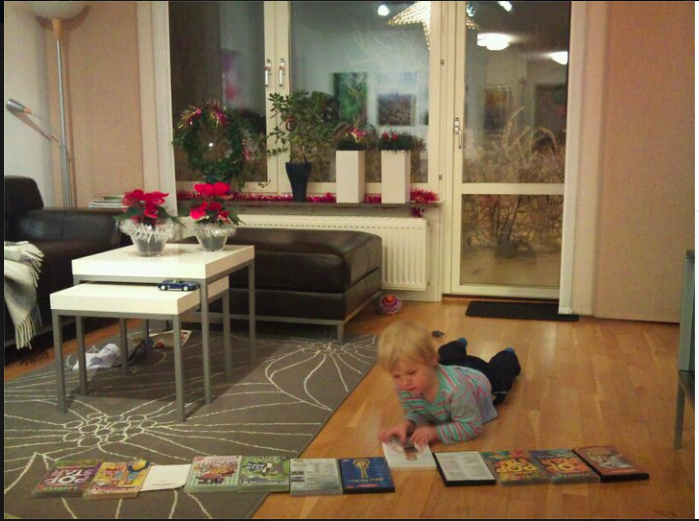
What’s a DVD?
Could IBM Watson replace my doctor?
![]() |
| Junior & I |
Now I’m on my way home from US. The visit to IBM was short and sweet. Really fun to see the heart of their research lab where magic happens and coolest ideas are being created by coolest people. But now that meetings are finished I realize that I caught cold, thanks to all that air conditioning. And luckily it’s US and the selection of pills to fight any disease is wide. So I search for a super-pill at Walmart and will for sure be recovered soon. Getting medication in Sweden is much more restrictive – one needs an ordination from a doctor. And our doctor is not extremely bright. Last time I visited him with my newborn Paul Jr who started to develop some rush on his skin the doctor had no clue. What he had was a lot of authority, but absolutely no clue about the reason of the skin rush. So he suggested that Junior may be intolerant to lactose. What? This does not make sense, especially since Junior never had stomach problems. And surely a mother of a small kid does not come unprepared to a doctor’s appointment in the era of big data, social networks and efficient search engines. Of course I had a number of possible diagnoses figured out that I presented to the incompetent doctor. And indeed, he liked my suggestions and prescribed the suggested medicines.
The Power of IoT
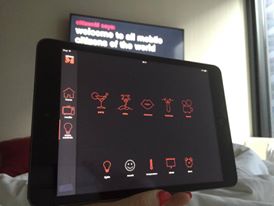
Today I am in New York with my colleagues from Ericsson Research meeting IBM Research. We are talking about the Internet of Things (IoT) – the trend of physical things becoming connected and available for developers to build services using them. And I am staying at this nice hotel at Times Square called CitizenM. The first thing I always do in when I enter my room is to search for a regulator somewhere on the wall to increase the temperature in the room. I fail at doing that but shortly after I discover an iPad with an application to control everything in the room – curtains, blinds, lights, TV, A/C, and even the color of the lighting in the bathroom. There are also modes you can choose between – romance, business, party, etc – that make the whole room change its character. How cool is that? Some years ago we enjoyed the Emergency Party Button videos on youtube (such as this one: https://www.youtube.com/watch?v=nZIfIzNW9xM), and now it has actually been implemented commercially.
Another cool example is Car2Go – a service where you can grab and drop off a Smart car anywhere in a city, that you control from an application on your phone. And if something is not working for you – just check that application – it has the answer. The state of all the car sensors is monitored by the cloud application, and if you try to end your rental while the trunk is open or when the car is parked a forbidden area the application will complain.
And what about the stage for Eurovision Song Contest? Last years’ performance of Måns Zelmerlöw started a trend, and this year every second artist used the cool animations provided by that stage. Did they get an API for that?
And the most interesting innovations will come with cross-domain interactions. IoT breaks the verticals and allows application developers to build their services across domains, which in its turn opens up a lot of new business values. Can the mood that I choose for my hotel room stretch to the car that I rent? I have been working with connected embedded systems for many years and still I get mind-blown when I see them in practice – it’s actually happening!
“… everything is possible”
Every new child in the world starts from the latest state of technological progress. We love technology, so our kids know that every room has a large screen and speakers where you can stream any content available on the web, cloud storage or devices. This is their starting point. Servitization is in their blood, devices around them are stupid, and services serving them are intelligent. When they want to get hold of some digital content they expect it to happen instantaneously and device- and location-independently. This is at least how my 8-year-old thinks. But what about my ½-year-old? He has no limits, not yet. He has not been told about the limits. How creative could he become if there were no technological limits? And isn’t it why we love virtual reality and prefer Minecraft instead of Lego. As my good friend and colleague Leonid Mokrushin once said: “If it’s software, everything is possible”.